
Confirm expected behaviour
- Thresholds, dashboards, health checks, SLO alerts.
- Great for known-unknowns (you can predict what to watch).
- Answers “Is it within expected limits?”.
Use to detect and notify quickly when SLIs breach targets.

Home › Resources › Observability vs Monitoring
Monitoring confirms expected health with metrics, thresholds and alerts. Observability explains the why behind failures and latency by correlating logs, metrics and traces. This vendor-neutral guide clarifies similarities and differences, when to use each, and a practical rollout plan for SRE/DevOps teams.
Monitoring = verify expected state (SLOs, thresholds) and alert fast. Observability = ability to ask any question of your telemetry (logs·metrics·traces) to explain the unknown. Keep monitoring as guardrails; add observability to reduce MTTR, speed incident analysis, and improve reliability.
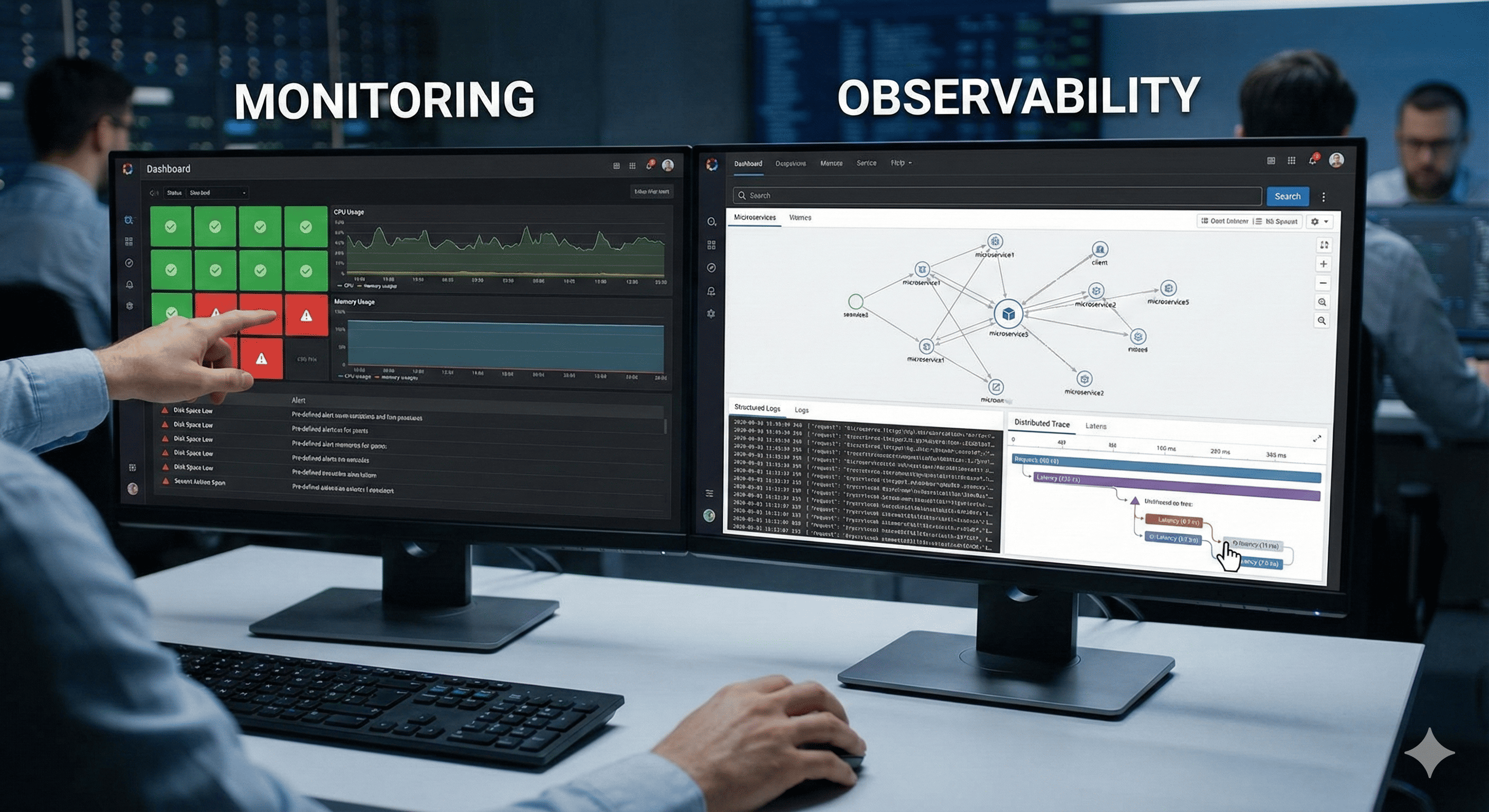
Monitoring confirms expected behaviour with thresholds and dashboards (known-unknowns). Observability explains why issues happen by correlating rich telemetry across logs, metrics, and traces (unknown-unknowns).
Use to detect and notify quickly when SLIs breach targets.
Use to diagnose and reduce MTTR with deep, ad-hoc querying.
Emit logs, metrics and traces (often via OTel). Consistent service/env/version tags are non-negotiable.
Correlate signals, search, slice by dimensions, apply AI/heuristics, build service maps and flame charts.
Trigger alerts, runbooks and release decisions; feed insights back to SLOs and CI/CD gates.
Keep lightweight monitoring for guardrails; add observability to explain and fix faster.
A quick, comparable matrix across the key dimensions teams care about.
| Dimension | Monitoring | Observability |
|---|---|---|
| Purpose | Confirm expected behaviour with thresholds & dashboards. | Explain why issues happen via rich, correlated telemetry. |
| Best for | Known-unknowns (predictable failure modes, SLIs). | Unknown-unknowns (novel failures, emergent behaviours). |
| Owners | Ops, SRE, app teams; product for guardrails/SLOs. | Platform/SRE, performance, developer experience, staff engineers. |
| Signals | Preset metrics, log patterns, health checks, pings. | Unified logs · metrics · traces (+ events, profiles, RUM). |
| Strengths | Simple, fast to alert, high signal-to-noise for SLIs. | Deep ad-hoc analysis, service maps, flame graphs, correlation. |
| Limits | Blind to novel failure modes; dashboard/alert sprawl. | Setup complexity & cost; requires consistent tagging/instrumentation. |
| Alert types | Threshold, rate-of-change, health checks, SLO breaches. | Multi-signal, correlated incidents; error-budget burn; causal grouping. |
| KPIs | Availability %, p95 latency on SLIs, error rate, uptime. | MTTR, time-to-detect/resolve, % incidents with RCA, DORA change failure rate. |
| Tooling examples | Nagios/Icinga, Prometheus + Alertmanager, Zabbix, CloudWatch Alarms. | Datadog, Dynatrace, New Relic, Elastic, Grafana (Tempo/Loki/Prom) + OTel. |
| Pairing | Keep guardrail monitors (SLOs, uptime, synthetics). | Use for RCA and exploration; feed insights back into monitors & runbooks. |
Rule of thumb: monitoring catches, observability explains. You need both.
Use these field-tested patterns to pick the right instrument first, then follow up with a complementary signal.
Start with RUM to quantify impact by route/geo/device (e.g., INP, LCP at p75). Then pivot to APM to isolate slow endpoints, DB calls, and downstream services.
Observability first: correlate logs, metrics, and traces to localize the blast radius. Then dive into APM spans and service maps for code-level root cause.
Gate releases with Synthetic checks for critical journeys and APIs across regions. Keep APM to validate backend changes and track p95 latency/error rate post-deploy.
Go APM first: inspect hot services, slow spans, N+1 queries, and external dependencies. Then reproduce with Synthetic to confirm fixes and prevent regressions.
Rule of thumb: run APM + RUM + Synthetic together, backed by an observability lake for incident investigation.
What each signal tells you, when to use it, and the pitfalls that hurt coverage and costs. Keep a balanced mix and make changes visible.
Low-cost, aggregate views (rates, ratios, gauges, histograms) for SLA/SLOs and capacity trends.
service, env, version.user_id) balloon cost and query time.
Hash/limit dimensions, use exemplars to link to traces.
Great for context and long-tail debugging; expensive if ungoverned.
trace_id/span_id.End-to-end request flows with spans for services, DBs, caches, queues and external calls.
Change awareness that accelerates RCA: see when/where behavior shifted.
The essential health indicators to watch continuously.
Each lens answers a different question. Use them together to validate impact, prevent regressions, and explain root cause.
Follow requests across services to pinpoint latency and errors.
See what users actually experience, by route, geo, device and network.
Proactively test uptime, SLAs, and critical user paths from many regions.
Build a portable telemetry pipeline: OTel SDKs + Collector, export via OTLP, add detail where it matters, and control costs & data residency from day one.
Use OTel SDKs + Collector and export with OTLP (HTTP/gRPC) to any backend.
Begin with auto-instrumentation; add custom spans where it counts.
service, env, version attributesPrevent surprise bills with sampling & retention before scale.
Keep data sovereign and private by design.
Turn telemetry into reliability outcomes: define SLIs/SLOs, improve alert quality, follow a crisp MTTR playbook, and use error budgets to guide release pace.
Track user-centric health and commit to targets by service & environment.
service, env, versionReduce noise, route fast, and protect on-call focus.
Locate hot services & dependencies. Check error spikes and p95 latency.
Overlay deploy markers & feature flags on the timeline.
Drill into slow endpoints, DB queries, cache misses, queue latency.
Pivot to scoped logs for error context; avoid blind grepping.
Budget consumption governs release pace and risk.
Choose the right telemetry & rollout approach for each architecture. Open a card for setup keys, gotchas, and the signals that matter.
service/env/versiontraceparent via ingress/meshKeep visibility high without runaway bills, enforce robust access & privacy, and guarantee EU residency or hybrid/on-prem when required.
Tune volume and retention early; pay for signal, not noise.
service/env/priorityAccess, privacy and auditability by design.
service,
env,
version.
Pin data to EU regions and align with regulatory requirements.
Ship signal fast, harden & scale, then institutionalize reliability.
Stand up the OTel pipeline and capture the first good traces.
Add depth, cost control and team workflows.
Extend coverage and lock in reliability habits.
Straight answers to the most common questions teams ask when upgrading from classic monitoring to full observability.
No. Monitoring confirms expected behavior with thresholds and dashboards. Observability explains why things broke using rich, correlated telemetry. You need both.
Start lean: uptime, key SLIs, and a few critical traces (transactions, DB calls). Scale to full observability only when incident causes become opaque.
You can correlate logs/metrics, but you lose causality and end-to-end latency paths. Traces are the backbone for fast RCA; add them early.
Observability: Platform/SRE lead the stack, standards and cost. Monitoring: service owners/dev teams define alerts, SLOs and runbooks for their domains.
OTel standardizes SDKs and the OTLP wire format. With the Collector you can route once, switch back-ends, and keep portable telemetry and pipelines.